Johnny Truant
House of LeavesJohnny Truant is the book’s central living intermediary: a man pursued by recurrent nightmares who inherits, edits, and physically sustains Zampanò’s manuscript. His decisive significance lies in the unstable overlap between witness and artifact. Johnny does not merely report what he finds; his fear, exhaustion, memories, and dependence on the manuscript become part of the material through which the story exists.
Identity and Introduction
Johnny first appears as a narrator speaking from the aftermath of experiences he cannot assimilate. He still suffers nightmares so frequently that familiarity has not made them ordinary. The distinction matters: repetition has produced neither mastery nor habituation, only a continuing exposure to fear. Sleep, which should offer relief, has instead become something that has stalked him for so long that even its inevitability feels threatening.
His desperation has led him to experiment with an extensive catalogue of remedies and intoxicants, including Excedrin PMs, Melatonin, L-tryptophan, Valium, Vicodin, barbiturates, bourbon, bong hits, and cocaine. The list is presented with grim comic exaggeration, but its cumulative effect is bleak. None of these substances has reached the kind of relief he needs, suggesting that Johnny’s problem is not a simple chemical imbalance that medication can correct. His body is attempting to mute an experience that remains structurally beyond it.
The Night at Zampanò’s Apartment
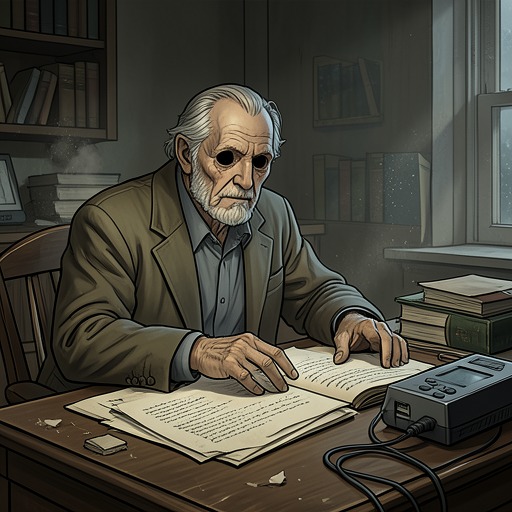
Johnny’s connection to the manuscript begins through his friendship with Lude. When Lude telephones at three in the morning, Johnny is asleep, but he leaves his bed and goes to Franklin because Lude is close enough to him to receive that unusual act of obedience. Lude is waiting outside the gate with an unsettling gleam, and Johnny later recognizes the journey as a threshold he should have refused.
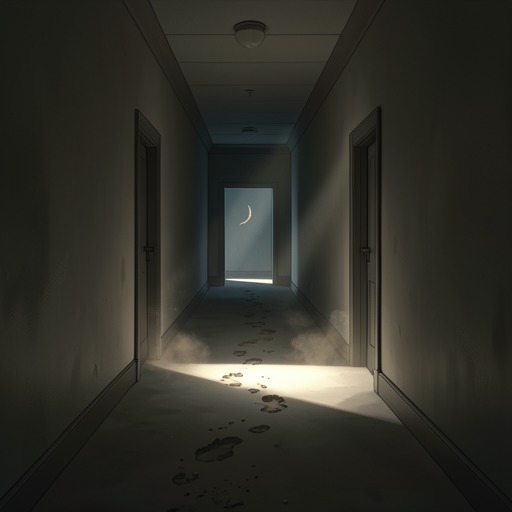
The approach to Zampanò’s apartment is retrospectively saturated with warnings. Johnny remembers the rattling keys, the gate hinges that shriek as though opening a crypt, the dank hallway buried in shadow, and Lude’s whispered disclosures. At the time, Johnny disregards these signs; afterward, they become fixed elements of memory and terror. His narration therefore moves backward from knowledge to innocence, showing a man who can see the disaster’s outline only after he has already entered it.
Johnny experiences his own past as an action that should still be interruptible. He watches himself being drawn forward by inertia, curiosity, or an unnamed force, and imagines screaming at the earlier self to stop and redirect the sequence. The inability to alter that scene becomes a model for his later condition: he is physically present in the aftermath but psychologically trapped in recurrence, compelled to revisit the moment without gaining control over it.
Change, Memory, and Psychological Burden
Johnny’s defining change is not a clean transformation from ignorance to understanding. It is the accumulation of belated recognition. The ordinary details of the night at the apartment become ominous only in retrospect, while the present is repeatedly invaded by remembered sounds, images, and consequences. His nightmares are thus not separate from his narrative work; they are the form in which the past continues to act upon him.
A compressed statement attributed to Johnny declares that he is not what he used to be. The line gives explicit shape to the discontinuity already visible in his conduct. The earlier Johnny could sleep, answer a friend’s call, and move through a dark building without understanding what those actions would cost. The later Johnny cannot return to that untroubled self, because memory has made the old identity unavailable.
The text also frames his suffering through an editorial acknowledgment that his asides may appear impenetrable but possess rhyme and reason. Readers are directed toward his father’s obituary and his institutionalized mother’s letters if they want greater understanding of his past. This arrangement makes Johnny’s identity deliberately incomplete within his own narration: his present voice offers symptoms and fragments, while family documents promise a context that he cannot or does not fully provide directly.
Johnny and the Manuscript
Johnny’s relationship with Zampanò’s work is figured as a bodily dependency. He finds the manuscript spread across a table beside other materials, bloodless and still but not dead, calling to him and needing him like a child. He describes himself as its source and caretaker, feeding it through paper, ink, and photocopied reproduction. The manuscript therefore becomes more than an object he has discovered: it is a dependent organism whose continued existence requires his labor.
This dependence reverses the usual hierarchy between reader and book. Johnny appears to animate the manuscript, yet the manuscript also commands his attention and organizes his life. Without him, he fears, it would perish; but his own language implies that without it he would be left with an even more unmanageable remainder of experience. The distinction between Johnny and the work consequently becomes unstable, as though author, editor, witness, and textual body were exchanging functions.
His labor is not presented as secure recovery. The pages are described as monstrous and possibly inaccurate correlates, material traces that must nevertheless be animated. Johnny understands both the necessity and the danger of this process: to preserve the manuscript is to continue exposing himself to what it contains. The book survives through him, but its survival prolongs his contact with fear.
Narrative Role and Significance
Johnny’s narrative role is that of an unreliable but indispensable mediator. His first-person interventions interrupt the surrounding material with exhaustion, anxiety, memory, and self-correction, preventing the reader from treating the manuscript as a transparent record. The story reaches the reader through a chain of damaged transmission: Zampanò produces the manuscript, Johnny discovers and sustains it, and the reader must interpret the fragments that both men leave behind.
That mediation gives Johnny a distinctive thematic function. He embodies the return of what cannot be mastered by ordinary explanation: nightmares recur, sleep becomes threatening, past actions remain painfully visible, and a dead man’s work behaves like a living burden. His statements do not resolve the mystery so much as reveal the cost of carrying it. Johnny is therefore not simply a guide through the book’s documents. He is the human surface on which the manuscript’s fear continues to register.